

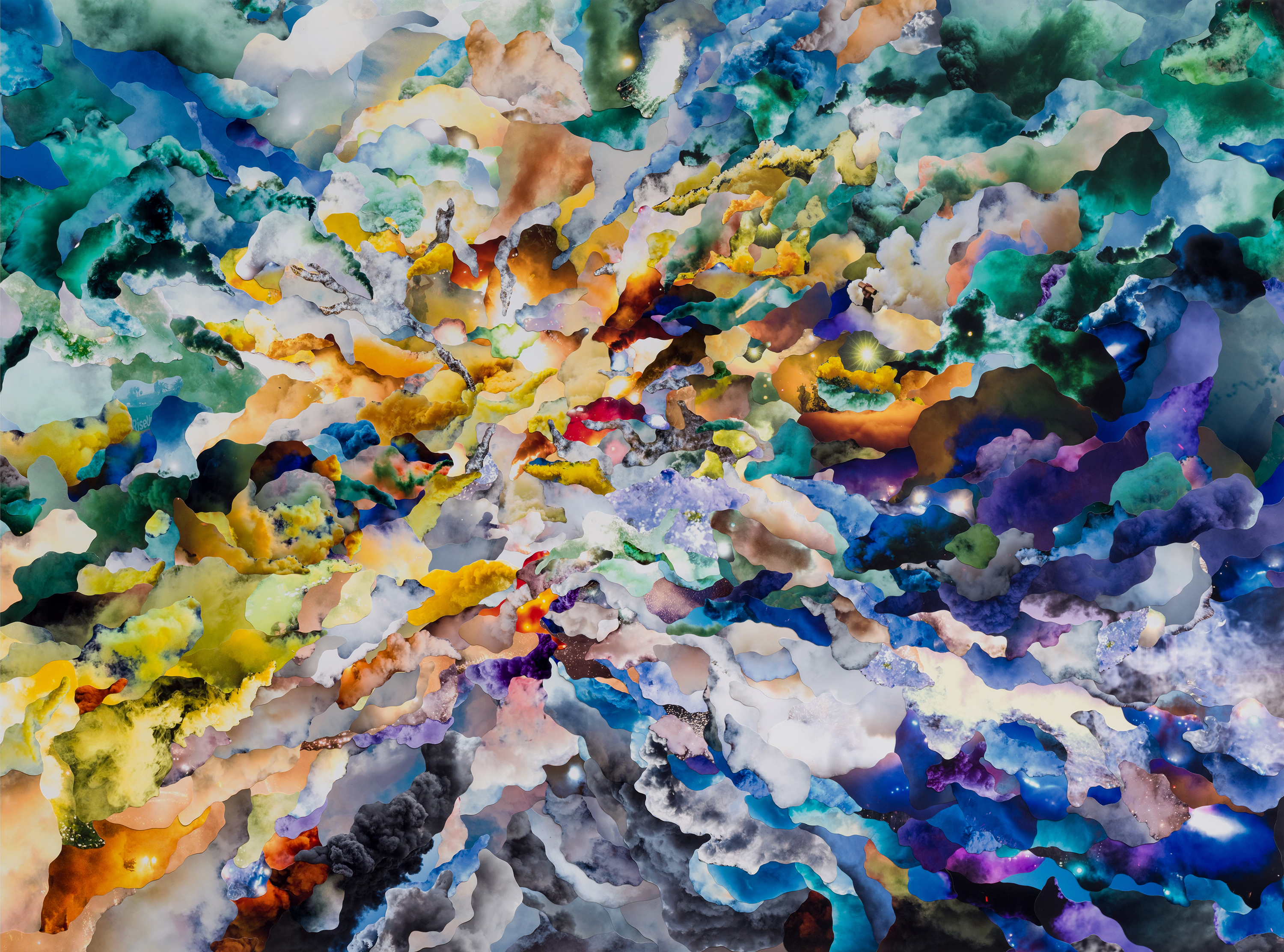
Image: Jemima WYMAN Haze 27 2024 hand-cut digital photographs, 104 h x 140 w cm. Private collection.
This work is comprised of hand-cut digital photographs with curved edges measuring 104 centimetres in height by 140 centimetres in width. The work is displayed in a white frame. The photographs capture images of plumes of smoke from flares, fires or deterrents present during protests combining to create one overall complete image.
Working from the centre and slightly to the right is the image of a bright yellow spark or flare, which acts as a focal point for the surrounding hand-cut digital photographs of smoke.
In the bottom left corner and moving towards the right, smoke shifts through deep purples, violets and blues, gradually moving into lighter blues and greys.
Moving across the middle of the artwork and starting from the bottom left, cut-outs of the smoke from lit flares and rising plumes of coloured smoke appear in burnt orange before mixing alongside lurid yellows and noxious greens.
Above this, in the top left corner, the smoke takes on cloud-like forms in shades of light green, pale blue and brown, before transitioning into deeper blues and greens into the top right corner.
These concentrated and contrasting smoke formations press up against one another, generating an energy that seems to thrum and swell to the surface. The composition draws the viewer inward toward the artwork’s centre point, then pushes them outward again—a visual vortex of pull and release, as though being drawn into the eye of a storm.
The result is a scene that feels otherworldly, a cosmos as vast and as timeless as the universe, encompassing space, time, matter and energy simultaneously.
Haze 27 is part of a series of collages first shown in Wyman’s solo exhibition, Fume in 2021 at Sullivan+Strumpf in Gadigal/Sydney featuring plumes of smoke from flares, fires or deterrents present during protest.
The artist writes, the Haze… series weaves images of smoke together to form nebulous landscapes (or smokescapes) that mimic the abstract shapes found in camouflage textiles. Activists, police and military use smoke as a tactical weapon in confrontations. I document these uses in the multi-page titles listing each piece of cut smoke with: the protest, the location, and the date. The result is an incomplete document of global unrest for a moment already passed. Ephemeral, and sometimes noxious, the particles caught in the air of these collages also contain rage. Smoke is a siren, a signal of past, current and future distress.